
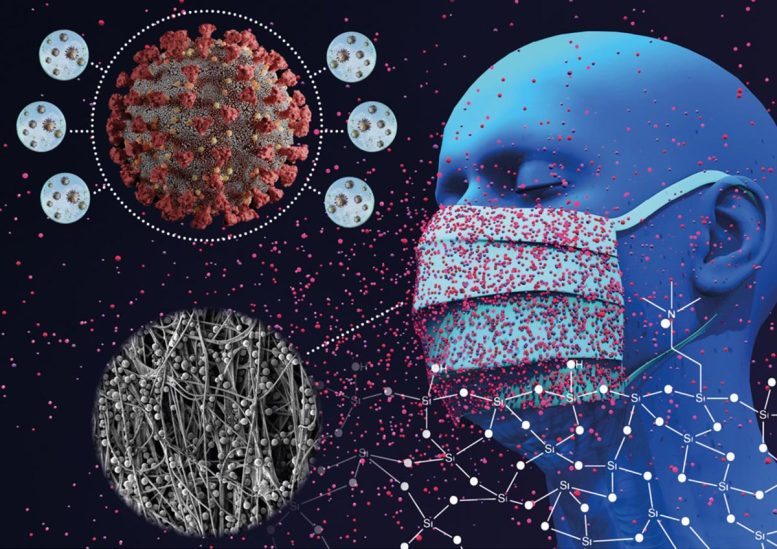
University of Liverpool researchers develop a new material that captures coronavirus particles and could transform the efficiency of face masks.
A research team at the University of Liverpool has developed a new material that captures coronavirus particles and could transform the efficiency of face masks and other filter equipment to stop the spread of COVID-19 and other viruses.
In a paper published in the journal Nature Communications, the team showed that the new material used in a conventional face mask was approximately 93% more efficient at capturing proteins, including coronavirus proteins, with little impact on breathability.
Revolutionary Protein-Capturing Technology
The Liverpool scientists behind the new material are Professor Peter Myers, a research leader in chromatography, and Dr. Simon Maher, a mass spectrometry expert.
They had been collaborating on high-performance liquid chromatography processes where proteins “stick” to the surface of the chromatographic support materials.
During the pandemic, Professor Myers realized that reversing this process would provide a way to absorb proteins, and specifically the protruding S1 spike protein which covers the outer lipid membrane of the SARS-CoV-2 virus.
Re-Tuning Silica Particles for Maximum Virus Absorption
Working together, the team from the University of Liverpool’s Department of Chemistry and Electrical Engineering and Electronics, “re-tuned” the surface of the spherical silica particle they used for chromatography to make the surface very “sticky” for the COVID-19 S1 spike protein.
At the same time, they increased the porosity of the silica particle to give it a very large surface area of 300m2 per gram, which is approximately the same area as a tennis court. Furthermore, they increased the internal volume of the silica sphere to provide a large capacity to “capture” the virus.
Expanding Applications Beyond Face Masks
The new material is at the proof of concept stage and the team has shown it works in face masks in addition to air filters such as those used in airplanes, cars, and air conditioning.
The group, which includes the Liverpool School of Tropical Medicine, also developed a method to attach the sticky particles onto the surface of a conventional face mask.
Professor Peter Myers said: “This proof of concept research has only scratched the surface and whilst COVID-19 is no longer a global threat to our health, this material has the potential to be used in a wide range of applications. Our research team is looking at developing more advanced “sticky” surfaces for a variety of bioaerosols including the new Covid variant BA.2.86 as well as influenzas and other deadly viruses such as Nipah.”
Reference: “Attaching protein-adsorbing silica particles to the surface of cotton substrates for bioaerosol capture including SARS-CoV-2” by Kieran Collings, Cedric Boisdon, Tung-Ting Sham, Kevin Skinley, Hyun-Kyung Oh, Tessa Prince, Adham Ahmed, Shaun H. Pennington, Philip J. Brownridge, Thomas Edwards, Giancarlo A. Biagini, Claire E. Eyers, Amanda Lamb, Peter Myers and Simon Maher, 18 August 2023, Nature Communications.
DOI: 10.1038/s41467-023-40696-x
Never miss a breakthrough: Join the SciTechDaily newsletter.
Follow us on Google and Google News.
3 Comments
This is mildly interesting. You wouldn’t want to be inhaling the silica particles detaching from the mask though, as silicosis causes lung disease. Also the particles attached to the fibers can adsorb the virus, but there’s such large gaps between the fibers of a paper mask that viruses should breeze right past the silica particles. However, a more efficient virus-trapping design could improve air filters.
It is sharp silica particles that get caught in the lungs and cause issues. This is supposed to be spherical.
What is the practical result of this? Even if we could extinguish COVID from the human population, it has apparently become established in the native wildlife, particularly deer, and feral and domestic-outdoor cats. I have no intention of wearing a mask for the rest of my life every time I leave the house. What is needed is a robust immunity at least among humans, if not also co-existing wildlife.